
Rotator cuff repair is famous for two things: how much better patients feel a year later, and how long the road to that year is. If you’re heading into this surgery, the most useful thing to understand is why the recovery is slow, because once the biology makes sense, the frustrating rules become bearable.
Protocols vary with the size of the tear, the quality of the tissue and your surgeon’s approach. Their plan beats this guide, every time.
The biology that sets the schedule
The rotator cuff is a group of tendons that hold your shoulder together and power its rotation. A repair reattaches torn tendon to bone with anchors and sutures. Here’s the catch: on the operating table, that reattachment is purely mechanical, stitches holding tissue in position. The actual healing, where tendon biologically knits back onto bone, happens over months.
Every rule in your recovery, the sling, the passive-only movement, the slow progression, exists to protect the mechanical repair while the biological one catches up. Patients don’t re-tear repairs because they’re unlucky; they re-tear them because a good week convinced them the schedule was too cautious.
Phase one: protection (the sling weeks)
Expect weeks in a sling, with the exact number set by your surgeon. Early life is one-armed: front-opening clothes, meal prep done in advance, everything important moved to counter height.
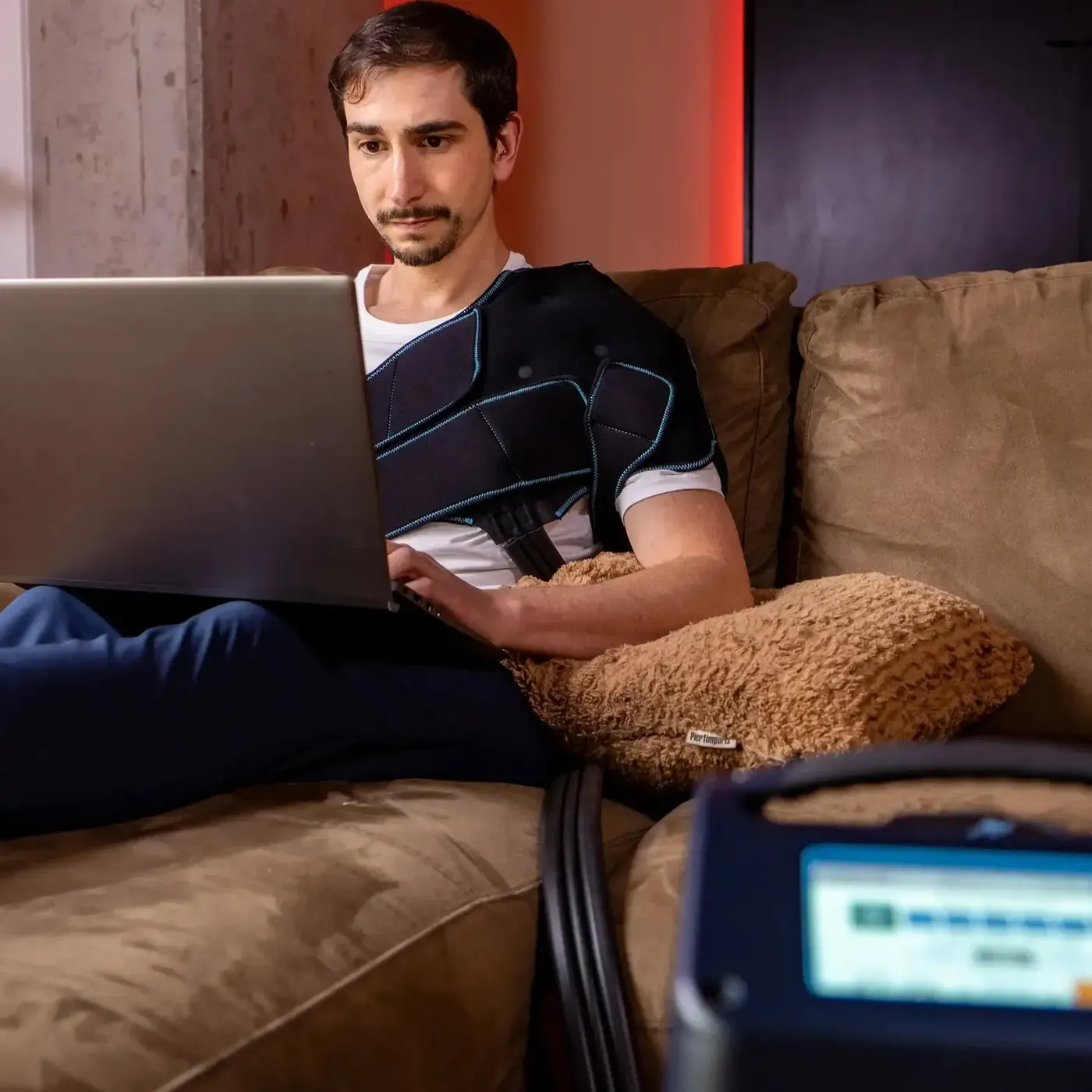
Swelling and discomfort peak early, and shoulders are awkward to ice, bags slide off the joint’s curve, and your only free arm is busy. Side-specific shoulder wraps solve this: left or right, in two size ranges, strapped in place while a circulating unit holds the temperature you set. This is the configuration we ship for shoulder rentals, and the reason we ask “which side?” when we call.
Nights are the hard part. Lying flat pulls on the repair, so most people sleep semi-upright, recliner or wedge pillow, for weeks. An evening cold session helps many people settle; overnight use is supported on the NICE1, with the temperature holding wherever you set it between 42°F and 58°F.
Phase two: passive motion
Physiotherapy typically starts surprisingly early, but with a twist: the therapist (or your other arm, or gravity) moves the shoulder while the repaired muscles stay switched off. Pendulum swings, guided stretches, pulley work, motion without muscle.
It feels strange to be told not to use your shoulder while also being told to move it constantly. Both instructions are the treatment: motion prevents the notorious post-surgical stiffness, while the passivity protects the healing tendon. Cold therapy after sessions helps manage the stirred-up soreness, a pattern that continues for weeks.
Phase three: active motion, then strength
Somewhere in the schedule, again, your surgeon’s call, you graduate to moving the arm under its own power, and later to resistance. The gains here are steady rather than dramatic: reaching a shelf, sleeping through the night, washing your own hair without strategy.
Soreness after progression is normal and responds to the usual toolkit. What’s not normal is sharp pain during exercises, that’s a “call your physio” signal, not something to push through.
The honest timeline
Full recovery from rotator cuff repair is measured in months, with strength continuing to build past the point where daily life feels normal again. The patients who do best tend to share three habits: they respect the sling schedule, they treat physio as non-negotiable, and they manage swelling and soreness consistently instead of heroically.
If a rotator cuff repair is on your calendar, our shoulder rental page covers the side-specific wraps, pricing, and having the system home before surgery day, set up for the one-armed weeks before they start.